New York prison escapee David Sweat has told investigators that the only worker involved in the breakout was seamstress Joyce Mitchell, a prosecutor said Monday.
Clinton County District Attorney Andrew Wylie offered that detail after a second prison employee arrested in connection with the escape, corrections officer Gene Palmer, made a court appearance.
Palmer is accused of being the courier Mitchell used to deliver frozen ground meat — hiding hacksaw blades — to Sweat and fellow lifer Richard Matt.
Palmer, 57, allegedly also provided other tools to the duo in exchange for some of Matt's artwork, according to court papers.
A New York State Police officer escorts suspended Clinton Correctional Facility guard Gene Palmer, left, from Plattsburgh Town Court in Plattsburgh, N.Y., Wednesday, June 24, 2015. Rob Fountain/Staff Photo / AP
The guard has denied any advance knowledge of the escape plot that put the convicted murderers on the run for three weeks and ended with Matt being shot dead and Sweat being wounded and captured.
And, according to Wylie, Sweat has not told investigators anything different.
"From what I understand in reviewing the reports today, he told investigators that Palmer had no involvement in the escape. It was just him and Mitchell and Matt," the DA said.
While Mitchell is still behind bars, Palmer is free on bail. He remained silent in court on Monday while his attorney waived his right to a preliminary hearing on the evidence against him.
The case is being transferred to county court and Wylie said he expects to present it to a grand jury within a few weeks.
Palmer's new attorney declined to comment on the allegations outside Plattsburgh Town Court.
Twenty years ago, Maria Davis got tested for the human immunodeficiency virus (HIV) as part of an application for a life insurance policy. She thought nothing of it until week and a half later, when she received a letter in the mail telling her she'd tested positive.
"It was devastating," she told CBS News. "I didn't know anyone else who was HIV positive. Back then it was known as the 'Monster' and thought of as a gay white man's disease."
Davis, a native of New York City who is now 55, soon learned that she contracted the virus from her then fiancé, who knew he was infected but did not tell her. With a successful career as a hip-hop promoter, working with artists like Jay Z, Queen Latifa, and P. Diddy, she felt she needed to keep her illness secret.
But in 1998, her condition declined rapidly and was hospitalized for over six weeks. Doctors informed her the virus had progressed into AIDS.
"I was 95 pounds," she said. "I was too weak to do anything. After all that I went through, I had to tell the world that this is serious and we need to talk about it."
Today, Davis's illness is under control and works to spread awareness and encourage others to know their HIV status.
In fact, people unaware that they are living with the virus contribute to nearly one third of HIV transmissions, the Centers for Disease Control and Prevention reports. According to new figures released by the CDC on Friday, 14 percent of the 1.2 million Americans with HIV don't know they're infected. The report was released just before National HIV Testing Day June 27.
Experts say that although HIV was once considered a death sentence, many people with the virus now go on to live normal, healthy lives.
"The medicines have become safer, simpler, and more effective," Dr. Cameron Wolfe, an infectious disease specialist at Duke University Medical Center, told CBS News. "If you wound the clock back 10 or 15 years, treatments involved multiple tablets that were more prone to giving people side effects and their ability to restore health was just not particularly effective compared to what's available now. Most of the patients I see today take one pill once a day and have absolutely no side effects neither from their pill nor the HIV. You would have no idea walking past them on the street that they were on HIV treatment."
As far as life expectancy in the United States, Wolfe said that if people are diagnosed in their 20s, "there's no reason that you shouldn't live through your 70s, provided that you know about it and pick it up early, you get connected to care, and that you maintain diligence with treatment." Getting tested and treated could not only improve their overall health, but prevent the further spread of the virus.
While certain populations, including gay and bisexual men and African Americans, are at a higher risk of contracting HIV, Wolfe said anyone who is sexually active should be tested.
"The more we move away from select groups and the more we try and move toward that this is part of a standard discussion that you have with your healthcare provider period, then I think the better we get," he said.
Davis, who is a spokesperson for Merck's HIV awareness campaign, Project I Design, also works with a number of HIV/AIDS organizations, including amfAR. She continues to speak out to spread the message of the importance of HIV testing.
"I have no problem telling people that I'm living with AIDS," she said. "The most important thing you can do is empower yourself. You don't have to be an activist like me, but what you can do is get tested and know your status."
Penn State's College of Liberal Arts today announced that several of its system's were the target of two cyberattacks in May, but officials found no evidence that personal identifiable information or research data were compromised.
However, school officials acknowledged that a number of Liberals Arts-issued usernames and passwords were compromised. Faculty and staff are being asked to choose new passwords for their college accounts.
The school will hold a news conference at 6:15 p.m. to discuss the attacks, first detected by a cyber-security forensic unit on May 4. They were made by unknown individuals, the release said.
The school implemented enhanced securitymeasures following another attack on its School of Engineering, which it announced in May.
"Penn State takes very seriously the security of the sensitive data in its care and we are continuing to investigate the circumstances that ultimately allowed attackers to access the networkin the College of Liberal Arts," Penn state provost and executive vice president Nicholas Jones said.
"Over the last several months at Penn State, we have implemented advanced monitoring techniques designed to better detect these intrusions, and this is what happened in this case. As we continue to see in the news, large organizations, including governments, corporations and universities, must do more to protect sensitive data from increasingly aggressive criminals. This is particularly challenging at at a large public research university, where collaboration and cross-pollination of ideas and information is at the very core of our academic mission."
The investigation into the College of Liberal Arts attacks revealed that the earliest signs of intrusion date to March 4, the release said. Its faculty, students and staff may experience disruptions in connectivity, but the college expects to return to full operation by tomorrow.
Presidential hopeful Donald Trump isn't waiting to be elected to start building borders.
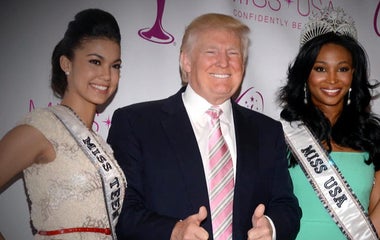
Trump, whose Miss USA pageant was dropped from the Univision network following his remarks about Latinos during a campaign address, has already threatened to sue the station for hundreds of millions of dollars, and now has escalated the conflict to ban all Univision employees from his Trump Doral Miami golf course.
Univision dumps Miss USA pageant over Trump's immigration remarks
Earlier this week Trump lost Univision's support to air the pageant on July 12 after the mogul said that Mexican immigrants are "bringing drugs, they're bringing crime. They're rapists." On Friday, the pageant's planned host, actress Roselyn Sanchez, resigned as Trump's employee, remarking that it would be "inconceivable" to go on hosting the show.
In his letter Trump promised that if he becomes president he would erect a "meaningful border ... not the laughing stock that it currently is," reported TMZ, and is apparently beginning with establishing strict border control at his golf course.
In response to banning Univision employees from playing golf on his 800-acre golf course and resort, the network sent a memo to all of its employees to avoid patronizing any Trump properties, anywhere.
"As part of this decision, UCI employees should not stay at Trump properties while on company business or hold event/activities there," the company directive stated.
Witnesses have described the horror and chaos of the gun attack on sunbathing holidaymakers in Tunisia that left at least 37 people dead and 36 injured.
At least five British tourists and an Irish woman died in the attack. Philip Hammond, the British foreign secretary, said the British death toll was likely to rise.
The shootings took place at about midday in the resort of Sousse, 93 miles (150km) south of Tunis on the country’s east coast. Tourists fled from the beach and barricaded themselves in their hotel rooms after a gunman opened fire on the crowded beach before moving into the pool area of the five-star Imperial Marhaba hotel while firing at tourists, witnesses said.
One suspected gunman was shot dead at the scene, and reports suggested another suspect was apprehended. The attack came on the same day as a bomb exploded at a Shia mosque in Kuwait City, killing 27 people, and a man was decapitated in France following an attack in which a man apparently tried to blow up a factory belonging to a US gas company in Saint-Quentin-Fallavier, near Lyon. French police found flags at the factory with Arabic inscriptions.
Of the attack in Sousse, Mohamed Ali Aroui, a spokesman for the Tunisian interior ministry, said: “The perpetrator of the operation was killed, but ... there could have been more of them. Whether there were other elements with him, we can’t confirm or deny.”
An official from the country’s health ministry said Britons, Germans, Belgians and Tunisians were among the dead. “There are still some people we have not identified yet, but we are working on it,” the official said. A foreign ministry spokesman said that at least 11 Britons, three Belgians and a German were among the wounded.
The Riu Imperial Marhaba Hotel, where the shootings took place, said the majority of the 565 guests at the hotel were from the UK and central European countries.
One couple from Kent told the Guardian they had been relaxing on their sunbeds when they heard what they believed at first to be fireworks, and saw a man running along the sand with what looked like a machine gun.
“He was shouting something, I don’t know what he was shouting,” said Glenn Whitehead, a scaffolder from Swanley, Kent. He shouted at his wife Anita to run, as bullets flew around them. A person lying next to them fell dead, he said.
The couple heard bullets close to their head, and Mrs Whitehead tripped in the sand as others ran screaming beside them. Staff from the hotel’s spa beckoned them inside, where about 20 other tourists and staff were waiting.
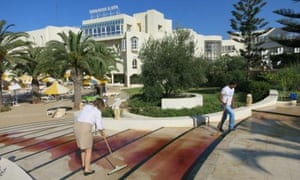
The couple said they waited for perhaps 20 minutes before they were led outside by staff, to find bodies lying by the hotel pool and in the foyer, amid pools of blood.
“I looked around the beach and all I could see were dead people covered in towels,” said Mr Whitehead. There was also a body on the sunbed next to the ones they had been using. “Where we were lying were a German mother and daughter. When I got back one of them was covered over, dead.”
“There was a lot of people who couldn’t get off their sunbeds,” his wife said. “They were elderly.”
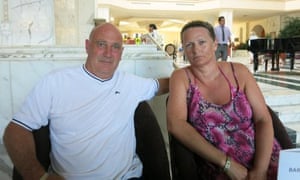
Glenn and Anita Whitehead from Swanley, Kent. The couple heard bullets close to their head as they fled. Photograph: Chris Stephen/Guardian
Witnesses told the Guardian that a British man had been killed while sunbathing on the beach as his wife packed their bags in their room ahead of their planned departure on Friday.
Another British woman described how her fiancé was shot three times as he lay next to her on a sunbed, using his own body to shield her from the bullets.
Sarah Wilson, from Pontypridd in south Wales, said her partner Matthew James was shot as the gunman opened fire, throwing himself in front of her before urging her to run for her life. He survived the assault but suffered wounds to his shoulder, chest and hip.
“We were just on the sunbeds, messing around and having a nice time when we heard these sounds. The shooting had started and there was a man with a gun opening fire all around. It is hard to remember just exactly what was going on,” she said. “I only saw the one man in dark clothing but people were being shot.
“Matthew put himself in front of me then he was hit, he moved and the man shot him again. Again he tried to move and he was shot again. He was shouting and blood was pouring out all over. I was screaming and it was chaos as more shots were coming out.
“We were down on the floor next to the sunbeds to shelter but the shots just kept on coming. He just told me to go, to look after our kids and that he loved me.”
She fled to the hotel and hid in a cupboard until it was safe to emerge, hunting for two hours on the beach until she learned James had been taken to hospital, where he had life-saving surgery.
“I’ve been to the hospital intensive care and I’m just staying here on a chair now. His pelvis was shattered by the bullet and he also had a heart attack. But he is alive. I’m just praying we can get out of here as soon as we can.
“There are bodies everywhere, some covered in blankets and some not. You can’t imagine how bad it is.”
Ray Butler, a member of the Irish Dáil, said he had spoken by telephone to the husband of a man from County Meath whose wife was shot dead on the beach while he was in the hotel inside. “He is absolutely distraught,” Butler said. Charles Flanagan, the Irish minister of foreign affairs, confirmed that an Irish citizen had been killed.
The assault took place within hours of two other suspected Islamist attacks in France and Kuwait. One man was detained near Lyon, south-eastern France, after the severed head of his former employer was hung from the gates of a gas factory. French officials said the man had been known to intelligence services.
In Kuwait City, a suicide bomber attacked a Shia mosque, killing 27 worshippers. Responsibility for the bombing was later claimed by the Islamic State group. There is no evidence that the three attacks were coordinated or connected.
David Cameron broke off from the European council meeting in Brussels to offer his “sympathy and condolences and solidarity” to François Hollande, the French president, and to Tunisia. “This is a threat that faces all of us … these events can happen anywhere,” he said.
Cameron pledged that Britain would do all it could to help, and insisted that the perpetrators were acting not in the name of Islam but “in the name of a twisted and perverted ideology that we must combat with everything we have”.
Speaking after he chaired a meeting of the UK government’s Cobra crisis committee in London, Philip Hammond, the foreign secretary, said: “The situation on the ground is still somewhat confused and we can’t be sure exactly how many [victims there are] but because of the nature of the composition of the tourist population in this part of Tunisia we have to assume that a high proportion of those killed and injured will have been British.
“We have had reports from families of those involved in the incident that allow us to confirm that at least five Britons have been killed in this incident, but I should warn that we must expect that there will be more reports of fatalities as we establish the detail on the ground.”
The British Foreign Office said it was urgently working with travel firms in Tunisia “to gather and confirm information on those affected by this attack”, and had despatched British embassy staff to the site of the atrocity.
Speaking from the scene several hours after the attack, Tunisia’s president, Béji Caïd Essebsi, called for a global strategy to tackle terrorism and insisted that his country could not be left to face jihadis alone.
The attack – the worst in Tunisia’s modern history – is a devastating blow to a country whose economy relies heavily on western tourism, and comes only three months after another two gunmen murdered 21 people, including one Briton, in an assault on the Bardo National Museum, one of the country’s leading tourist attractions. There were no immediate claims of responsibility.
Sousse was also the scene of a failed suicide bombing attempt in October 2013, when a man was spotted approaching a hotel in a suicide vest and chased on to the empty beach, where he blew himself up.
The country’s tourist economy had taken a major blow in the aftermath of the 2011 “Jasmine” revolution but with new elections in late 2014, was returning to stability. Tourist receipts in 2015 are already down by 15% on 2014 following the Bardo attack.
By late afternoon, the corpses, most of them in black body bags, had been gathered by a bar and pavilion. The Guardian was shown several bodies of elderly tourists in shorts and bathing suits still lying where they had been killed. Others had been evacuated by the emergency services, using sunbeds as stretchers.
Dazed tourists, clearly in shock, ordered beers from the terrace bar still dressed in their swimsuits. One man from had ordered lobster and was drinking a beer while cleaners mopped up blood around his feet. He said he had seen someone killed, but did not want to be named.
Gary Pine, a product manager from Bristol who was staying at the El Mouradi Palm Marina hotel, said he heard an estimated 20 to 30 shots before tourists ran to their hotels for cover. “Over to our left, about 100 yards [90 metres] or so away, we saw what we thought was firecrackers going off,” he told Sky News. “But you could see quite quickly the panic that was starting to ensue from the next resort along from us.
“Only when you could start hearing bullets whizzing around your ear do you realise it was something a lot more serious than firecrackers.
“My son was in the sea at the time and of course my wife and myself were shouting for him to get out of the sea quick and as we ran up the beach, he said: ‘I just saw someone get shot.’ As we exited the beach there was some kind of explosion from the complex next door. So we knew that a situation was developing, if not had ended.”
Elizabeth O’Brien, an Irish woman who was holidaying with her two sons, said she had heard what she initially thought was gunfire, before realising it was gunfire.
“So I just ran to the sea to my children and grabbed our things and as I was running towards the hotel, the waiters and the security on the beach started saying ‘run, run, run!’ and we just ran to our room.”
If you want a picture with Mickey and Minnie, you might have to ask someone else to take it.
Disneyland and Disney World have banned selfie sticks starting Tuesday, due to safety concerns.
"We strive to provide a great experience for the entire family, and unfortunately selfie sticks have become a growing safety concern for both our guests and cast," Suzi Brown, a spokeswoman for Disneyland Resort, said in a statement to the Los Angeles Times.
Guests' bags will be checked for rogue selfie sticks near the parks' entrances, according to our sister newspaper, the Orlando Sentinel. Park goers will have an option of handing over the selfie-sticks for later pick-up or going back to their cars or hotel rooms to leave the behind, the news outlet reported.
The latest move appears to extend a ban started earlier this year, when the park barred selfie sticks on rides.
Many park goers, however, didn't get that memo.
Just this week, the California Screamin’ roller coaster at Disney California Adventures Park was shut down after a passenger pulled out a selfie stick mid-ride -- creating the potential for a deadly hazard, the Orange County Register reported.
Now, the ban extends to the rest of the park.
Selfie sticks, of course, are those extendable poles that allow you to get extreme angles while talking photos of yourself and others.
They are widely reviled by travelers, except, of course, for the ones doing the angling.
Selfie sticks pose a variety of safety concerns given their ability to become an instant weapon -- even by mistake. (Who among us hasn't almost lost an eye to an exuberant picture taker trying to line up the perfect shot?)
President Barack Obama has hailed as "a victory for America" the U.S. Supreme Court ruling Friday that same-sex couples have the right to marry anywhere in the United States.
In a five to four decision, the high court declared that the U.S. Constitution's guarantees of due process and equal protection for all overrule any state's attempt to outlaw same-sex marriages.
Previously only 36 of the 50 states plus the District of Columbia had allowed gay marriage.
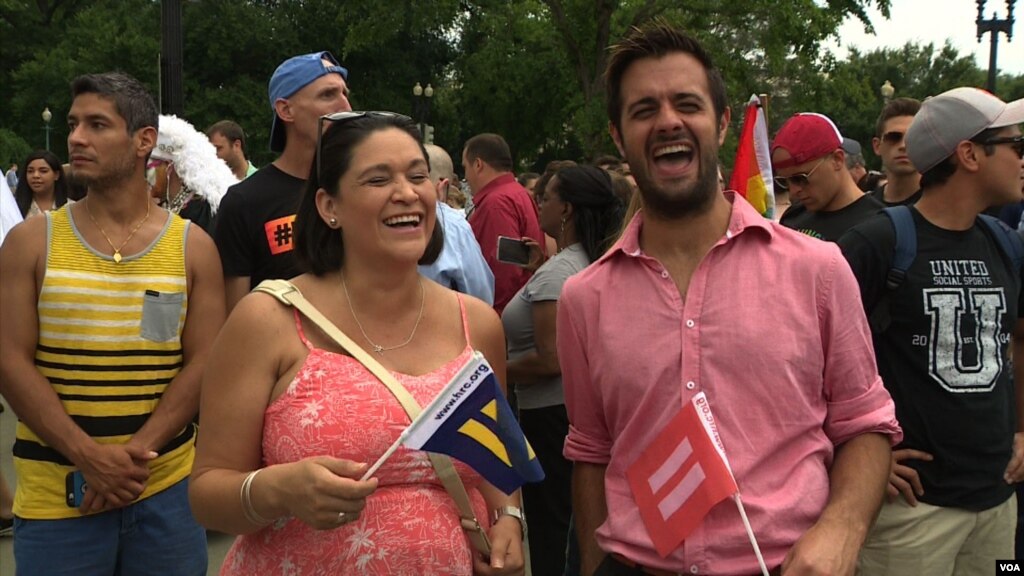
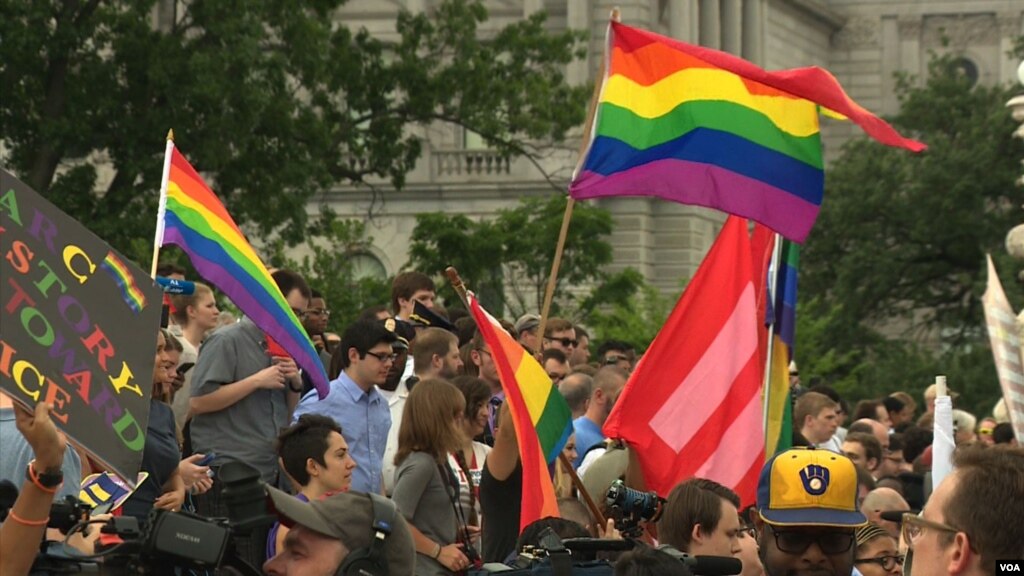
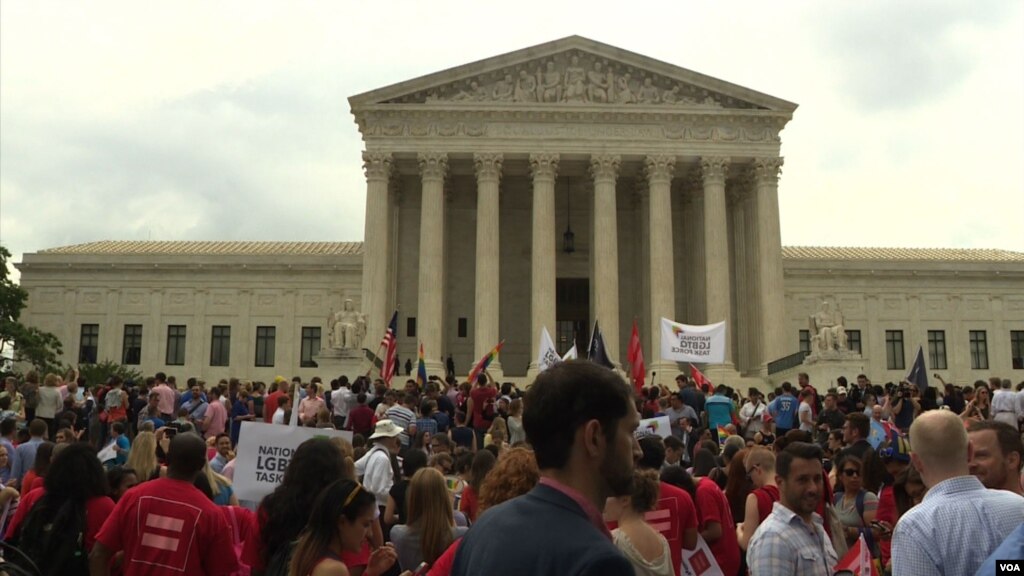
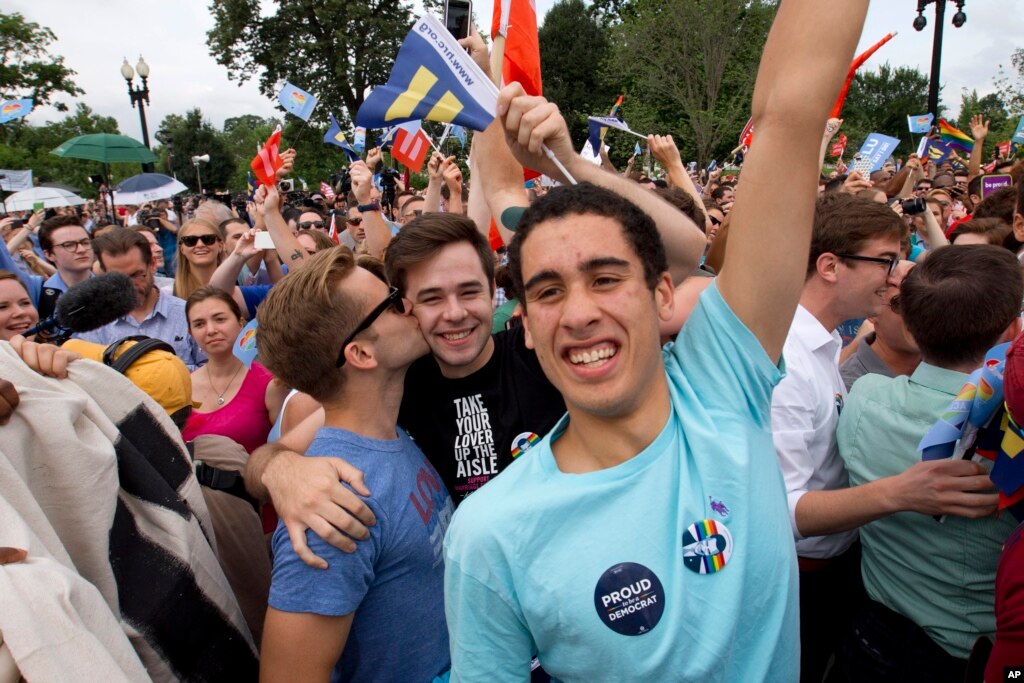
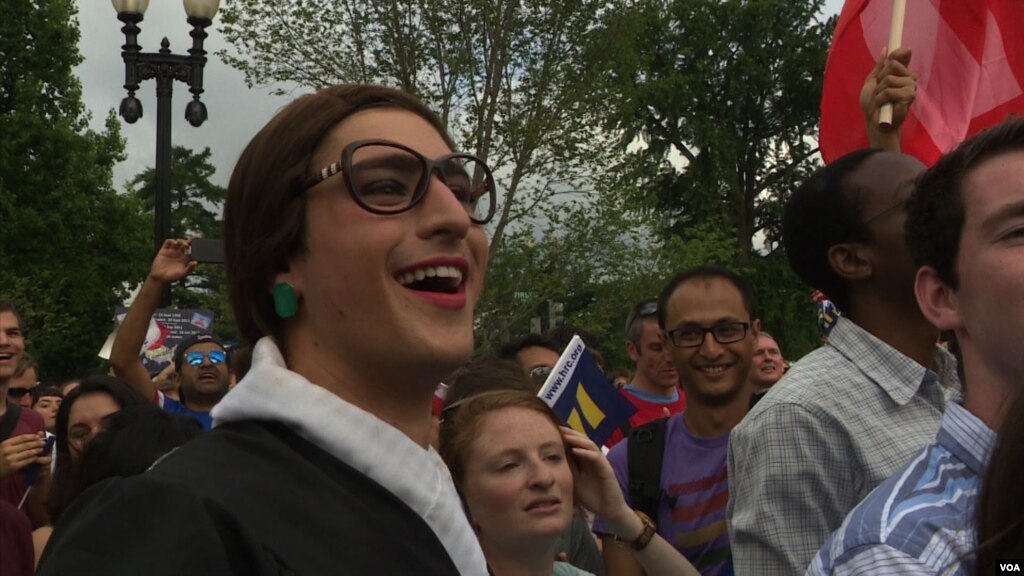
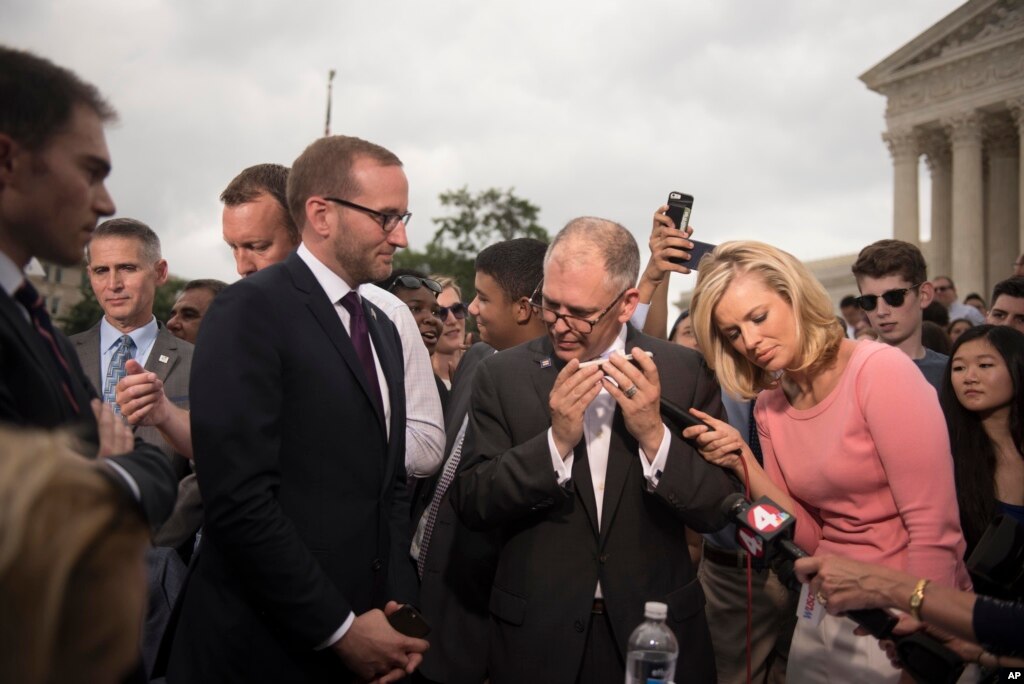
Gay marriage supporters broke out in cheers as word of the decision spread over a crowd of hundreds who had gathered outside the court building.
"This decision will end the uncertainty hundreds of thousands of same-sex couples face. It will strengthen all of our communities," Obama said at the White House after the historic ruling.
"Progress often comes in small increments, sometimes two steps forward, one step back," he continued. "Sometimes, there are days like this – when that slow, steady effort is rewarded with justice that arrives like a thunderbolt."
"America should be very proud," Obama said.
WATCH: Related video of President Barack Obama
Obama telephoned the lead plaintiff in the case, Jim Obergefell, congratulating him on live television.
In 2013, Obergefell sued the state of Ohio over its refuals to list him as the surviving spouse on the death certificate John Arthur, the man Obergefell married in Maryland where same-sex marriage is legal.
WATCH: Jim Obergefell reacts to Supreme Court Ruling
Since Ohio banned same-sex marriage in the state, the state did not recognize the Obergefell's marriage to Arthur.
"America has taken one more step toward the promise of equality enshrined in our Constitution, and I'm humbled to be part of that," Obergefell said after the ruling.
Obergefell spoke to reporters outside the court. “Today’s ruling from the Supreme Court affirms what millions across this country already know to be true in our hearts, our love is equal and that the four words etched above the Supreme Court, “Equal Justice Under Law”, apply to us too.”
Tony Perkins, president of the Family Research Council, said on Twitter the ruling was a “shocking abuse of power, and will never be accepted.”
Speaker of the House John Boehner issued a statement, saying he was "disappointed that the Supreme Court disregarded the democratically enacted will of millions of Americans by forcing states to redefine the institution of marriage."
Boehner's statement also said that "marriage is a sacred vow between one man and one woman, and I believe Americans should be able to live and work according to their beliefs."
Representative Nancy Pelosi, leader of Democrats in the House, called the Supreme Court's ruling on gay marriage a “transformative” decision, saying the ruling “unequivocally affirmed that equal justice under the law means marriage equality” for gay, lesbian, bi-sexual and transgender Americans.
“This decision is about creating a future where loving, committed families are able to live with dignity. This is about freedom. This is about love,” she said.
Justice Kennedy Writes for the Majority
Justice Anthony Kennedy wrote the majority decision just as he did in three previous gay rights cases before the court dating back to 1996. Kennedy wrote that gays and lesbian couples asked for “equal dignity in the eyes of the law.” He added, “The Constitution grants them that right.
Conservative Justice Antonin Scalia was among the four dissenters. He wrote the decision shows the court is “a threat to American democracy.”
Conservatives Vow to Fight On
Gay marriage opponents were also out in force in front of the court including Jennifer Marshall with the conservative Heritage Foundation. Marshall said the battle over gay marriage will continue.
“Well this is a disappointment because the court should have respected the fact that nothing in the Constitution required the re-definition of marriage. Marriage policy has historically been and should remain under the authority of states and the American people. The court has issued a decision but it will not end the conversation about what marriage is any more than the Roe versus Wade decision has ended the abortion debate.”
The outcome is the culmination of two decades of Supreme Court litigation over marriage, and gay rights generally.
The ruling is the Supreme Court's most important expansion of marriage rights in the United States since its landmark 1967 ruling in the case Loving v. Virginia that struck down state laws barring interracial marriages.
Public Opinion Shift
Public opinion has shifted strongly in support of gay marriage in recent years, said analyst Karlyn Bowman of the American Enterprise Institute.
“American’s views about gay marriage have changed remarkably fast in terms of being more accepting of gay marriage overall," Bowman said.
"And it has been one of the most rapid transformations I’ve seen in public opinion, in part because so many know someone who is gay or have a friend who is gay or a family member who is gay and that kind of proximity has actually created greater acceptance," he added.
Georgetown University law professor Nan Hunter told VOA’s Mike Bowman outside the court that Friday’s decision reflected that shift in public opinion. “I’m not sure America changed today. I think the court today said we see how America has changed.”
The Islamic State of Iraq and Syria claimed responsibility for a suicide bombing at a Shia mosque in Kuwait City after Friday prayers, killing 27 people and wounding 227 others, according to Reuters, citing the country's Interior Ministry.
"This incident targets our internal front, our national unity," Prime Minister Sheikh Jaber al-Mubarak al-Sabah told Reuters after visiting the wounded in hospital. "But this is too difficult for them and we are much stronger than that."
The explosion struck the Imam Sadiq Mosque in the neighbourhood of al-Sawabir, a residential and shopping district of the country's capital. A posting on a Twitter account known to belong to ISIS said the attack was carried out by a suicide bomber named Abu Suleiman al-Muwahed, who was wearing an explosive belt. The ISIS affiliate that claimed responsibility for the attack calls itself the Najd Province, and is the same group that took responsibility for a pair of bombing attacks on Shia mosques in Saudi Arabia in recent weeks.
Kuwaiti parliament member Khalil al-Salih, who was at the mosque when the attack occurred, said worshippers were kneeling in prayer when the bomber walked into the religious centre and detonated explosives, destroying walls and the ceiling.
"It was obvious from the suicide bomber's body that he was young. He walked into the prayer hall during sujood [kneeling in prayer]. He looked ... in his 20s, I saw him with my own eyes," he told Reuters by telephone.
"The explosion was really hard," he said, adding that more than 2,000 people were praying at the mosque at the time.
A witness at the scene in Kuwait City said the explosion took place near the end of a prayer that is traditional to Shia worshippers. (Kuwaitna News via Associated Press)
Police formed a cordon around the mosque's complex immediately after the attack, banning people from entering or gathering near the area. Ambulances could be seen ferrying the wounded from the site.
Paramedic Abdelrahman al-Yusef said most of the victims were men or boys who were at the mosque. He said medics treated at least 179 people.
"We couldn't see anything, so we went straight to the wounded and tried to carry them out. We left the dead," said Hassan al-Haddad, 21, who said he saw several bodies.
The attack on Kuwait's Imam Sadiq Mosque during Friday prayers was claimed by the same group that took responsibility for a pair of recent bombing attacks on Shia mosques in Saudi Arabia. (Saudi Gazette)
Abdullah al-Saffar, who was at the mosque, said the explosion took place just after Friday midday prayers, which are typically the most crowded of the week. Attendance increases during the holy Muslim month of Ramadan, which started last week.
Another witness, Ahmad al-Shawaf, said worshippers were standing shoulder to shoulder in group prayer when the explosion struck near the door of the mosque, behind some of those praying. Al-Shawaf said the explosion took place near the end of a prayer that is traditional to Shia worshippers.
He said witnesses standing behind him said they saw a man walk in, stand in the back with other congregants and detonate his device.
'Terrorist, cowardly action'
Kuwaiti Justice, Religious Endowment and Islamic Affairs Minister Yacoub al-Sanna described the attack as a "terrorist and cowardly action which threatens our nation."
Al-Sanna told the Kuwait News Agency that the government would take all necessary measures to ensure the protection of houses of worship.
"Kuwait was and will remain the oasis of security and safety to all components of the Kuwaiti society and sects," he said.
It was the first suicide bombing at a Shia mosque in Kuwait and worst militant attack in the country for many years.
ISIS regards Shia Muslims as heretics and refers to them derogatively as "rafideen" or "rejectionists." The ISIS Twitter statement said the bomber had targeted a "temple of the apostates."
The Shia population comprises between 15 and 30 per cent of the predominantly Sunni Muslim Gulf Arab state, where members of both communities are known to live side by side with little friction.
CHARLOTTESVILLE, VA. — The man who allegedly killed University of Virginia sophomore Hannah Graham is scheduled to go to trial in July 2016, after a local judge set the trial date Thursday.
Albemarle County Circuit Court Judge Cheryl V. Higgins also declined to recuse herself from the case against Jesse L. Matthew Jr. Matthew, 33, who faces the possibility of a death sentence on charges related to the disappearance and slaying of Graham, an 18-year-old from Fairfax County who went missing in September.
Video surveillance from that night shows Matthew and Graham walking together; she was never seen alive again.
Capital defender Douglas Ramseur filed a motion this month asking for Higgins to be removed from the case because her daughter was a U-Va. sophomore at the time of Graham’s disappearance. Higgins’ daughter attended a vigil for Graham before her body was found.
In court Thursday, Ramseur argued that Higgins should recuse herself to avoid “the appearance of impropriety.”
Albemarle Commonwealth’s Attorney Denise Lunsford argued that it would be nearly impossible to find a Virginia judge who lacked any connection to Virginia’s flagship public school.
Higgins declined to recuse herself, saying she could “fairly and objectively” oversee the case and has no bias in the matter. But she also ruled that a second Albemarle judge could be brought in “out of an abundance of caution,” to decide any pre-trial motions regarding the use of evidence from search warrants Higgins signed in the early days of the case.
During the hour-long proceedings, Matthew spoke only once. Dressed in an orange jumpsuit, he stood to waive his right to a speedy trial, struggling to raise his right hand — which was chained to his body — as he was sworn in.
Higgins set pretrial motions and scheduled the trial for four weeks, beginning July 5, 2016.
Matthew was convicted earlier this month on three charges related to a 2005 sexual assault in Fairfax County. He will be sentenced in October and faces the possibility of three life terms in prison after he pleaded guilty to attempted capital murder, abduction with intent to defile and sexual assault charges.
President Obama boldly declared Thursday that his legacy largely has been secured, and political analysts say the president could find new political momentum following the Supreme Court’s validation of his signature health care reform law.
The win cements Mr. Obama’s biggest domestic achievement to date and ends, at least for now, the constant debate over the legality of the Affordable Care Act, allowing the administration to focus its attention on other domestic and foreign policy aims.
Thursday also brought another major win for the president, one that could enable him to secure historic trade agreements during the supposed “lame duck” era of his tenure.
Political analysts say it remains to be seen whether Mr. Obama can seize the momentum he gained Thursday and use it to make progress on other key priorities, many of which appear to have little chance of clearing Congress. The president still is seeking a comprehensive immigration reform bill, gun control legislation, a budget that rolls back sequestration cuts and other goals. He’s also seeking support from Congress on nuclear negotiations with Iran and on new authorization to conduct the war on the Islamic State.
Despite those and many other questions still swirling around the White House agenda, Thursday was a landmark day for Mr. Obama.
On health care, the president wasn’t shy in articulating how he believes his namesake law now is part of the fabric of America. In a Rose Garden speech shortly after the Supreme Court handed down its 6-3 decision in favor of Obamacare, the president proudly placed the law — and himself — in the history books.
“Three generations ago, we chose to end an era when seniors were left to languish in poverty. We passed Social Security, and slowly it was woven into the fabric of America and made a difference in the lives of millions of people,” he said. “Two generations ago, we chose to end an age when Americans in their golden years didn’t have the guarantee of health care. Medicare was passed, and it helped millions of people. This generation of Americans chose to finish the job — to turn the page on a past when our citizens could be denied coverage just for being sick.”
On trade, the president was able to narrowly avoid what looked to be a crushing defeat for the White House and a clear rejection of his agenda. Earlier this month, House Democrats blocked a key piece of Mr. Obama’s trade package — a measure that provides financial assistance to workers displaced by trade deals.
But the president, with plenty of help from Republican leaders on Capitol Hill who support Mr. Obama’s desired trade deals, kept the issue alive. The White House consistently said Mr. Obama expected Congress to deliver his entire trade package, and administration officials put both public and private pressure on Democrats who ultimately caved and approved the measure Thursday.
“The president has been successful at staving off an otherwise slow or sluggish end to his term. That’s been to his credit. He’s done this in a way which has been uncharacteristic of the Obama White House,” said Brandon Rottinghaus, a political science professor at the University of Houston who has written about presidential leadership. “In this case, the White House was willing to put itself into some of these negotiations … He put his credibility on the line in a way he hadn’t since Obamacare had passed.”
Researches are beginning preparations for the first human trials of synthetic blood cells, produced in a laboratory. These trials should happen within the next two years; and they are beginning of one the most significant medical developments in recent history.
Dr Nick Watkins, from the University of Cambridge, is the NHS Blood and Transplant Assistant Director of Research and Development. He describes: “Scientists across the globe have been investigating for a number of years how to manufacture red blood cells to offer an alternative to donated blood to treat patients. We are confident that by 2017 our team will be ready to carry out the first early phase clinical trials in human volunteers.”
Furthermore, Dr. Watkins attests, “These trials will compare manufactured cells with donated blood. The intention is not to replace blood donation but provide specialist treatment for specificpatient groups.”
Yes, that is important to remember: this project is not intended to replace human blood. However, the development will provide more options for patients in desperate need of healthy blood. Perhaps synthetic blood is not a permanent solution but it may also provide health workers with a stop gap measure that can give doctors more time to treat a patient.
Indeed, he says, “Research has laid the foundation for current transfusion and transplantation practices. Continued investment in research and development is critical to our role in saving and improving lives through blood and organ donation. Our five-year research and development plan will ensure we advance treatment of all who depend upon our products and services.”
He also goes on to explain that “The manufactured red cell trials form part of our world-leading work in regenerative medicine and one of eight research goals for 2015-2020 that will bring long-term improvements for patients and donors.”
Pakistan has rejected accusations by Afghanistan's spy agency that a Pakistani intelligence officer helped orchestrate an attack on the Afghan parliament earlier this week.
The Foreign Ministry said in a statement today that the allegations aim to "disrupt the improving relations between the two brotherly nations".
It condemned "terrorism in all its forms" and said it would continue to work with Kabul to combat it.
Hassib Sediqqi, spokesman for Afghan intelligence services, said yesterday that an officerin Pakistan's Inter-Services Intelligence helped the Haqqani network carry out Monday's attack, which killed two peopleand wounded more than 30.
Relations between the two countries have improved in recent months following years of tensions, during which each had accused the other of supporting militants operating along their border.
Before you decide to beat the heat at the public pool this summer, consider this: The Center for Disease Control in the U.S. says its not the chlorine that makes your eyes red, it's all the urine.
The gross revelation came during an interview with Women's Health magazine, just in time for the Center's annual Healthy Swimming Program.
"Chlorine binds with all the things it's trying to kill from your bodies, and it forms these chemical irritants. That's what's stinging your eyes. It's the chlorine binding to the urine and the sweat," Michael J. Beach, Ph.D., associate director of the CDC's Healthy Water program, told the magazine.
And if you're not grossed out enough, consider that cough you can get from swimming at an indoor pool. Yep, that's from urine and sweat too.
The same trapped chemical, he said, can irritate lungs when you breathe it in.
It's all the more reason to make sure you shower before jumping in.
"If you're talking about thousands of people using the same pool, those germs can really add up," Beach said.
Obamacare is here to stay. And markets are telling investors loud and clear which companies are getting the biggest shot in the arm from the law.
Traders Thursday are surging back into the stocks that were the biggest beneficiaries from the Patient Protection and Affordable Care Act Thursday. And there’s no question – it’s the hospitals.
The healthcare facilities stocks in the Russell 1000 are up an average of 7.7% Thursday on the news that the Supreme Court upheld one of the most key aspects of the healthcare law. That blows away the average 0.7% gain by the stocks in the entire healthcare sector of the index. And hospitals are trouncing the shares of the insurers, or managed health care stocks, with their average 1.7% gain.
All five of the best performing healthcare stocks in the Russell 2000 where all hospitals.
BEST PERFORMING STOCKS IN THE RUSSELL 1000 TODAY ARE ALL HOSPITALS
Company
Symbol
% Ch. Thursday
Thursday price
Tenet Healthcare
THC
14%
$57.11
Community Health Systems
CYH
13.1%
$62.53
HCA Holdings
HCA
8.7%
$90.66
Universal Health
UHS
8.2%
$141.38
LifePoint Health
LPNT
7.9%
$83.61
Sources: S&P Capital IQ, USA TODAY research
Thursday’s trading action is golden to anyone who has wanted to known which companies are scoring most from Obamacare. It’s a massive one-day reaction that where investors are hanging it out in plain view which stocks they’re willing to pay more for due to the benefits due to the law. Investors are getting rare and pure look at the true winners from Patient Protection and Affordable Care Act Thursday – as the Supreme Court upheld the key aspect of the law. The bill was signed into law on March 23, 2010.
Some thought insurers would be the big winners, but it’s actually hospitals, which are now able to recoup more costs and lose less when providing care to patients without insurance.
And it’s not just speculation. Take Tenet Healthcare, one of the largest hospital operators in the U.S. It’s the biggest stock winner on the day – showing that investors think the stock is an outsized winner. The numbers tell the story. The company’s revenue has completely exploded since the Affordable Care Act was signed into law. Tenet’s revenue has doubled from 2010 reaching $17.1 billion through the last twelve months ended in March 2015. Compare that with revenue growth before the law was passed. Revenue grew just 6.5% between 2005 and 2010 – the five years prior to the law being passed.
Tenet’s total revenue has exploded since passage of Affordable Health Care (Chart source: S&P Capital IQ)


![[File Photo]](http://kwtv.images.worldnow.com/images/8179520_G.jpg)